
Research
My research explores:
Quantum channels
In Ref. [1], we introduced the concept of Pauli Component Erasing (PCE) channels. For a single qubit, the Pauli components are the coordinates of the Bloch vector, \(r_k = \text{Tr}(\rho \sigma_k)\), representing the projection of the state \(\rho\) onto the Pauli basis. For an \(N\)-qubit system, these generalize to \(r_{\vec{k}} = \text{Tr}(\rho \, \sigma_1^{k_1} \otimes \ldots \otimes \sigma_N^{k_N})\).
A PCE map \(\vec{\tau}\) transforms these components as \(r_{\vec{k}} \to \tau_{\vec{k}} r_{\vec{k}}\), where \(\tau_{\vec{k}} \in \{0, 1\}\). Effectively, the map either preserves (\(\tau_{\vec{k}}=1\)) or erases (\(\tau_{\vec{k}}=0\)) specific Pauli components (see Fig. 1). However, not every erasing pattern \(\vec{\tau}\) constitutes a physically valid evolution. For example, a map that projects the Bloch sphere onto the \(xy\)-plane (erasing the \(z\)-component) is forbidden because it violates complete positivity.
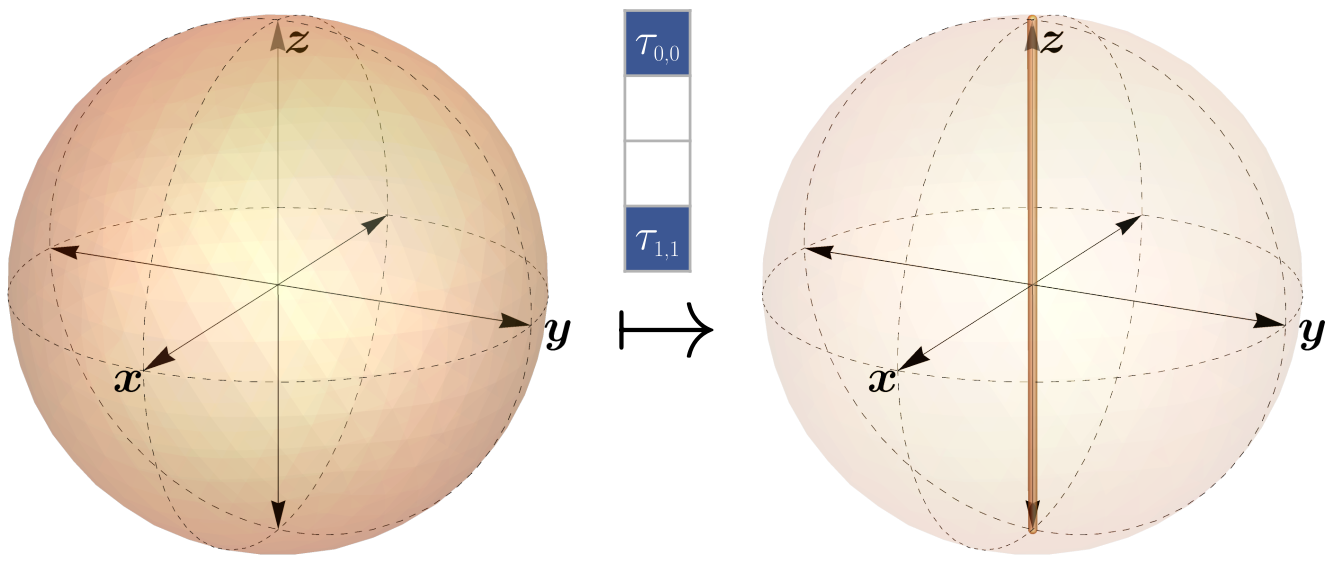
We found that for a PCE map to be a valid quantum channel, the set of preserved indices \(\mathcal{H} = \{\vec{k} : \tau_{\vec{k}} = 1\}\) must form a subspace of the finite vector space \((\mathbb{Z}_2 \times \mathbb{Z}_2)^N\). This result establishes a one-to-one correspondence between all completely dephasing-like channels and the finite vector subspaces of the Pauli group.
Quantum chaos
Can the BHS y GHS conjectures be put into a single framework?
Quantum walks
References
- Jose Alfredo de Leon, Alejandro Fonseca, Francois Leyvraz, David Davalos, Carlos Pineda, “Pauli Component Erasing Channels”, Physical Review A 106, 042604 (2022). arXiv:2205.05808v2